Pages

Sunday, December 28, 2014

Chapter 22 - Reckonings

Well, I must say, in this chapter there's a whole lotta beatin' goin' on. Between Claire being "punished" for risking the lives of the rest of the group, to Jamie sharing some of his youthful experiences with punishment, there is no lack of bruised and/or swollen hind ends or hands.

Not having read any of the fan comments that I'm sure are out there in regards to Jamie's treatment of Claire, I can only say that, for the time period and her behavior, she definitely put herself in a place for this to happen. I was actually surprised to see that Diana brought this aspect of accountability into the story; quite honestly, it makes Claire's situation so much more believable to me. Consequences for actions; who would have guessed?
“Do ye realize, Claire,” he said quietly, “that all of us came close to bein’ killed this afternoon?” I looked down at the quilt, shamefaced. “Yes, I know. My fault. I’m sorry.” “Aye, so ye realize,” he said. “Do ye know that if a man among us had done such a thing, to put the rest in danger, he would ha’ likely had his ears cropped, or been flogged, if not killed outright?” I blanched at this. “No, I didn’t know.” “Well, I know as you’re not yet familiar wi’ our ways, and it’s some excuse. Still I did tell ye to stay hid, and had ye done so, it would never have happened. Now the English will be lookin’ high and low for us; we shall have to lie hid during the days and travel at night now.”
Based on the ramifications of her actions, Jamie's response appears to me to be measured and appropriate. He would be right in saying that any man who had jeopardized their mission so severely would easily have suffered a worse punishment. And the response of the rest of the men as they ate dinner at the inn, dismissive and edged with silence, would be a natural reaction to this type of behavior.

As Claire reciprocates by ensuring Jamie sleeps on the floor, she was, as she puts it, "torn between fits of rage and philosophy". This also surprised me. There's a depth to some of her surmisings that caught me off guard. She admits to "having trouble with the scale of things"; "things" being what was truly a priority based on her future-knowledge of the ravages of mechanized war. It was hard for her to relate her actions among the clan fightings to the broader context of WWII.
A man killed with a musket was just as dead as one killed with a mortar. It was just that the mortar killed impersonally, destroying dozens of men, while the musket was fired by one man who could see the eyes of the one he killed. That made it murder, it seemed to me, not war. How many men to make a war? Enough, perhaps, so they didn’t really have to see each other? And yet this plainly was war—or serious business at least—to Dougal, Jamie, Rupert, and Ned. Even little rat-faced Murtagh had a reason for violence beyond his natural inclinations. And what about those reasons? One king rather than another? Hanovers and Stuarts? To me, these were still no more than names on a chart on the schoolroom wall. What were they, compared with an unthinkable evil like Hitler’s Reich? It made a difference to those who lived under the kings, I supposed, though the differences might seem trivial to me. Still, when had the right to live as one wished ever been considered trivial? Was a struggle to choose one’s own destiny less worthwhile than the necessity to stop a great evil?
Heavy thoughts, these. And not without precedent. My wife is a huge Lord of the Rings fan, and reading Claire's musings in her final sentence there regarding choosing personal destiny over resisting evil reminds me that the very same question is the root ethic of the Lord of the Rings epic.
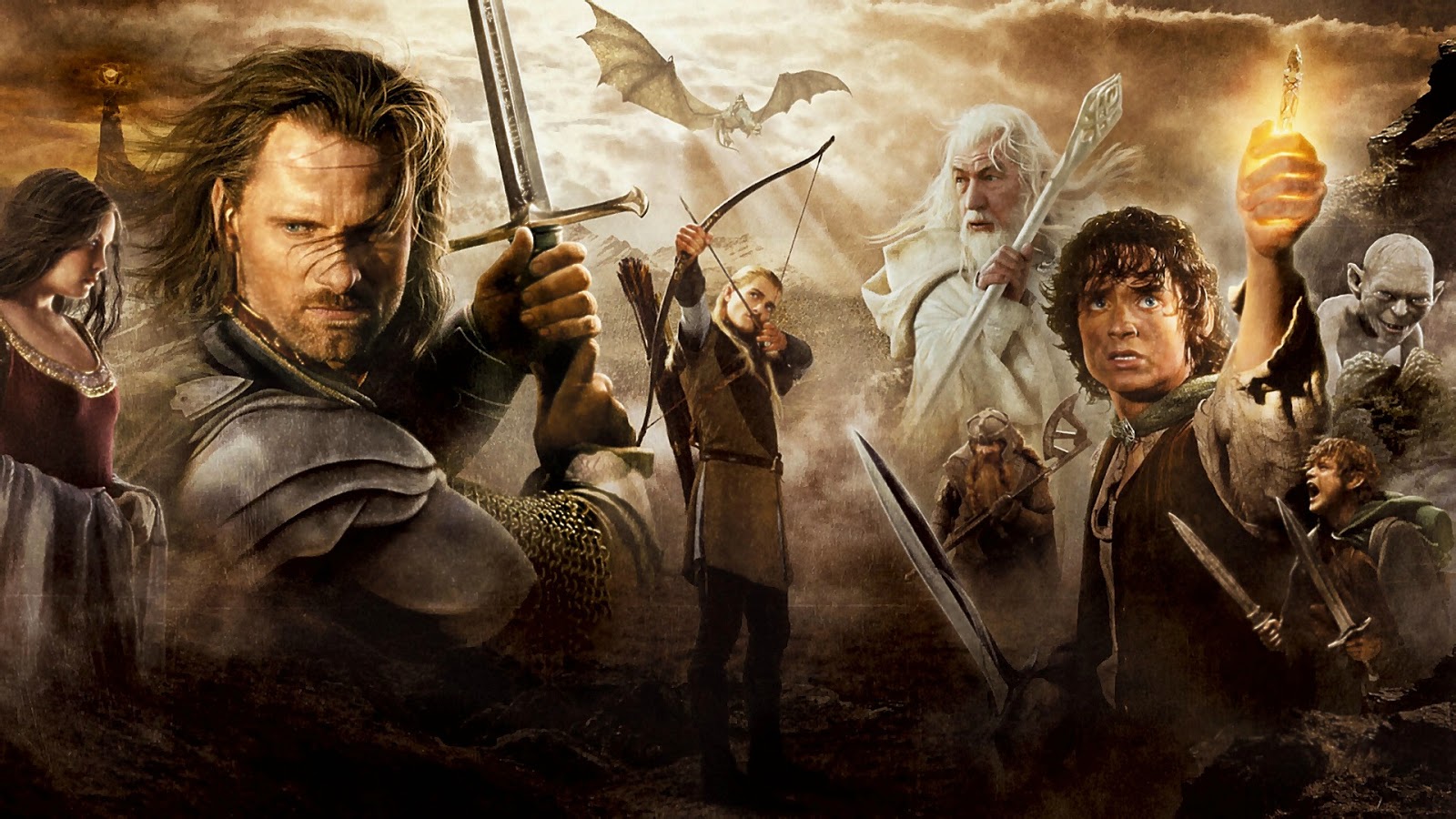

Me personally, I'm not big on war. I have a hard time trying to determine what a "just cause" is. Typically, the truth of any conflict rarely surfaces until it's over, and the form and shape of the war simply follows base ethics of the participants. That probably comes across sounding pretty liberal for someone who is most certainly more conservative than most, and who served four years in the US Air Force, but, there it is. Time molds and changes our opinions as we grow, to be sure.

Continuing on, as they travel all night toward the Red Boar at Bargrennan, Jamie opens up and begins to reveal some of his own childhood thrashings. Jamie's intentions are to remove the sting of Claire's own predicament (no pun intended) by sharing some of his own self-deprecating moments, yet there's a ring of authenticity to his overall message. I was sensibly repulsed by his revelation of Randall's true intentions with him when he was a prisoner at the Fort, yet captivated by the story of his father's death during Jamie's flogging.

Through all of this, Claire finally comes to a measure of understanding regarding the motives behind Jamie's actions, and while she ultimately forgives him, she makes it clear that she will not be tolerant of Jamie laying a hand on her again. Although in Jamie's oath to her (upon her dirk), he simply says he would never lay a hand on her "in rebellion or anger". That certainly doesn't preclude another episode of defiance on Claire's part.


Sunday, December 21, 2014

Chapter 21 - Une Mauvais Quart d'heure after Another

"One Bad Time Shift after Another." Yes, I had to go to Google translate to find out what the heck it meant.

I really liked this chapter. It had a lot of good stuff: the tense and witty dialogue between Randall and Claire; the gripping suspense of what he was going to do to her; the surprise rescue by Jamie; the daring escape from Fort William; and a good ol' adrenaline-fueled argument between the newlyweds. Let's break it down.

Good dialogue. And a good cartoon. :)
I LOVE good dialogue. Diana does not disappoint. The repartee of Randall and Claire in the barracks was thoroughly enjoyable, each character dancing around the situation, verbally lunging and parrying, thick with sarcasm and bluff. After sharing a glass of claret, Randall twistedly declares:
“I had forgotten to offer you felicitations on your marriage,” he said suddenly. “Forgive my lack of manners.” “Think nothing of it,” I said graciously. “I’m sure my husband’s family will be most obliged to you for offering me hospitality.”
And later:
The tension was slightly relieved by the entrance of an orderly, bearing a tray of tea things. Still silent, Randall poured out and offered me a cup. We sipped some more. “Don’t tell me,” I said finally. “Let me guess. It’s a new form of persuasion you’ve invented—torture by bladder. You ply me with drinkables until I promise to tell you anything in exchange for five minutes with a chamber pot.” He was so taken by surprise that he actually laughed. It quite transformed his face, and I had no difficulty seeing why there were so many scented envelopes with feminine handwriting in the bottom left-hand drawer of his desk. Having let the facade crack, he didn’t stifle the laugh, but let it go. Finished, he stared at me again, a half-smile lingering on his mouth. “Whatever else you may be, Madam, at least you’re a diversion,” he remarked.
As Claire struggles to find out her immediate fate, she comes up with a half-remembered name from Frank's research: the Duke of Sandringham, and she finds an opportune moment to inject the reputation for an unknown result. Randall falters briefly:
"...if you were working for Sandringham, why the devil would you act in such a damned ridiculous manner?” “Perhaps the Duke is testing your loyalty,” I suggested at random, preparing to leap to my feet if necessary. His fists were bunched at his side, and the discarded riding crop was within much too easy a reach on the desk nearby. He snorted in response to this suggestion. “You may be testing my gullibility. Or my tolerance to irritation. Both, Madam, are extremely low.” His eyes narrowed speculatively, and I braced myself for a quick dash.
Unfortunately for Claire, the intended result was achieved. However, such a bold ploy in the presence of a truly unstable individual simply motivates Randall's foregone conclusion to rape her.

Enter the wonderful timing of Jamie with the now famous, TV-series-cliffhanging-line:
“I’ll thank ye,” said a cool, level voice, “to take your hands off my wife.”
In the scuffle and escape that ensues, I totally bought the whole scene, and found it wonderful.
“You bluffed your way in here with an empty gun?” I croaked hysterically. “If it were loaded, I would ha’ just shot him in the first place, wouldn’t I?!” Jamie hissed.
Good point, J-man. Jamie then satisfyingly overpowers Randall, and both he and Claire jump out the window and escape over the fort barricade in the midst of a diversion elsewhere in the compound. A dashing execution of hastily-drawn-up plan by Jamie, as we come to find out later in the passionate argument that ensues when they reach safety.
Do ye know where I got the gun I used?” I shook my head numbly, my own anger beginning to fade. “I killed a guard near the wall. He fired at me; that’s why it was empty. He missed and I killed him wi’ my dirk; left it sticking in his wishbone when I heard you cry out. I would have killed a dozen men to get to you, Claire.” His voice cracked. “And when ye screamed, I went to you, armed wi’ nothing but an empty gun and my two hands.” Jamie was speaking a little more calmly now, but his eyes were still wild with pain and rage. I was silent. Unsettled by the horror of my encounter with Randall, I had not at all appreciated the desperate courage it had taken for him to come into the fort after me.
Upon making up and forgiving each other, they head off to the inn at Doonesbury with Dougal and the rest of the men to recover and gather their senses.

What strikes me about the scenes in this chapter is the intensity of emotion in every different place the narrative takes us. No one is an innocent or silent bystander; every character is heavily-weighted and charged with raw energy that leaps through the dialogue. I am beginning to sense the blurred lines when it comes to describing the kind of story that Outlander is, and why it appears to straddle several genres of "traditional" novels. This type of rich writing in this chapter easily demonstrates the ongoing appeal of the story to so many people over the years.

Sunday, December 14, 2014

Chapter 20 - Deserted Glades

At the beginning of this chapter, Claire receives a gift from Jamie that was sent to the happy couple from Hugh Munro.
...on my blanket rested a small parcel, done up in a sheet of thin paper, fastened with the tail-feather of a woodpecker thrust through the sheet. Unfolding it carefully, I found a large chunk of rough amber. One face of the chunk had been smoothed off and polished, and in this window could be seen the delicate dark form of a tiny dragonfly, suspended in eternal flight.
Of course, I'm sure all of you women swooned over the poetic inscription that Hugh Munro had scribbled hastily, quoting from Catullus. Yet, at this point, all my guy-brain could think of was: insect imbedded in amber; only one place this story could go now:
Okay, so maybe that wasn't the case, but after a little more convoluted Fraser back-story, what with Jamie having been shot by either Dougal or Rupert, Claire comes to find out that if Jamie dies, she inherits Lollybroch. Hey, not bad after losing her original husband to a future time, her current husband to a past time, at least she would end up with a little Scottish land deal.

Once more, the amorous couple is after it again, but this time, savagely interrupted by a couple of English deserters. Really, you would think the English, even deserters, would have a bit more decorum than to interrupt them in the middle of...ahem. Anyway, with her new-found fighting skills, Claire makes short work of the attempted rape, while Jamie makes short work of, well, basically just more killing. Seems these two can never catch a break. Oh, wait. I just kept reading and...there it is, they were able to finish now.

So now, as Jamie is trying to ensure his meeting with Horrocks goes off without a hitch, he tries to make sure that Claire will stay put, out of harms way. Yeah; Claire stay put. Right.

True to form, she remembers where she is and, realizing she is only seven miles from Craigh na Dun, she heads off to the infamous stone circle. I thought it was interesting how quickly she was abandoning her new-found husband for the chance to be reunited with her original husband. (Diana can't win with me, as I have been complaining all along how Claire seemed to never think of Frank up to this point). Anyway, fickle as I am, it still seemed a bit abrupt, even to the point of unusual as she imagines Jamie finally hooking up with Laoghaire:
And finding no trace of me, eventually he would forget me, and wed again. Perhaps the lovely young Laoghaire, back at Leoch.
Yeah. Consoling yourself with leaving Jamie by having him shack up with Laoghaire, Claire. That is classic justification if I've ever seen it.

Here's a woman who doesn't know what she wants, running here and there to keep the hope of her desires alive. Problem is, every time she doesn't get what she wants, she finds some other obstacle to pull her even further in to the quagmire of confusion and chaos. This time, it happens to be a botched "escape" to the hill of Craigh na Dun.

And, once again, off to to Fort William we go.

Sunday, December 7, 2014

Chapter 19 - The Waterhorse

Such a short, yet poignant, chapter. Claire's strange encounter with the waterhorse is the stuff that any out-of-town visitor to Loch Ness would relish.
It gave me an odd feeling to see the place again; so little had changed. Or would change, I should say.
I love how this simple statement made my brain skip for a moment; I had to re-think what the implications were and then....ohhhh yeah, that makes sense. Any changes Claire had previously seen were actually after the fact; a little reminder of her current time-challenge predicament.

As she watches the tentative waterhorse (or, rather, they watch each other), Claire describes the animal compared to the replica she had previously seen at the British museum, and how recognizable the basic shape was:
The colors of living things begin to fade with the last breath, and the soft, springy skin and supple muscle rot within weeks. But the bones sometimes remain, faithful echoes of the shape, to bear some last faint witness to the glory of what was.
Diana's naturalist side seems to be poking out through there, as well.

Peter, one of the drovers of their party, also witnesses Claire's encounter with the waterhorse, and Claire finds the superstitious nature of highlanders is alive and well.
“Ha-have mercy, lady,” he stammered. To my extreme embarrassment, he then flung himself flat on his face and clutched at the hem of my dress. “Don’t be ridiculous,” I said with some asperity. “Get up...It’s only a wee monster,” I said at last, and grabbing his hand, tugged him to his feet.
What I love about this book is the little side-trips I can take while thinking about the current chapter. In this instance, it occurred to me that I didn't know the origin of the term "waterhorse" and thought it would be interesting to find out.

From what I can tell, the waterhorse is considered a mythical animal based on Greek stories of the hippocampus, a water creature with webbed feet and the head similar to a horse's.
A rendering of a hippocampus from the early 1500's.
Finding the picture above led me to discover Conrad Gessner, a botanist from the 1500's from whose book this image is taken. Seems that Conrad was also an innovator, and that prior to his contributions to the literary world, naturalist books were rarely found with pictures, but his were full of beautiful woodcuts like the above. Nowadays it seems difficult to imagine describing various botanical items without any pictures to help describe them.

I also enjoy using pictures for other reasons:


Sunday, November 23, 2014

Chapter 18 - Raiders in the Rocks

This chapter was a bit different than other recent chapters; it seemed more, um, manly. There's a lot of fighting, swordplay, and knife training going on. And of course more sex. I'm half-tempted to think that Diana was challenged to a wager that she couldn't write a chapter that would appeal more to men. I would bet she won the wager.
The only other manly thing missing from this chapter...
One of the first things encountered is the after-effects of the wedding. I like how the reaction of Randall is downplayed; this is a fine point that may have been missed in any other novel. Sometimes the main characters begin to take on an oversized value within the confines of the narrative, but this does not seem lost on how Claire's marriage is portrayed from the perspective of Randall's point of view (via Dougal):
“He’s more to worry about than one stray Sassenach wench, no matter how pretty.” He raised an eyebrow and half-bowed toward me, as though the compliment were meant in apology. “He’s also better sense than to rile Colum by kidnapping his niece,” he said, more matter-of-factly.
Not only how Randall would think about it, but how the balance of power in the MacKenzie clan would be affected. What would the ramifications be beyond the immediate needs of keeping Claire safe? In my estimation, this tends to bring flesh and blood to the characterizations, as they have potential for consequences beyond the immediate story.

As they were settling in for the evening after dinner around the campfire, I did like the little story about the waterhorse, and learned some trivia about the legends:
These beings, I was given to understand, inhabited almost all bodies of water, being especially common at fords and crossings, though many lived in the depths of the lochs.
And here I thought there was only one in the depths of the Loch Ness.
The truth about the Loch Ness monster.
The raid brought things back to the seriousness, and dangers, of the mission at hand. The casual nature
of the men shifting positions around the campfire while moving closer to their weapons had a ring of authenticity to it. Also, I liked the fact that there wasn't a lot of screaming or talking during the fighting, just lots of grunting and shuffling while the hand-to-hand fighting is taking place. This, I'm sure, is how much of the adrenaline-fueled skirmish fighting was carried out. We tend to think in terms of modern movies with characters shouting their catch-phrases at each other, but a good ol' fight was probably just a bunch of dull thuds and groans. I find it hard to imagine Jamie making some sort of witty comment to best his opponents; he would be much more likely to just beat them to a pulp, but with grace and style, I'm sure.
One of Jamie's less used fighting catch-phrases.
The field skirmish brings the reality of the times to the foreground, as well. It had to be difficult from a safety perspective to travel on long journeys, something that we take for granted in our modern vehicles and interstate highways. Understanding some of these dangers, and seeing the fighting up close, certainly brought a tangible urgency to training Claire how to defend herself. These are obvious skills needed for the times.
I was timid and extremely clumsy at first, but Rupert was a good teacher, very patient and good about demonstrating moves, over and over. He rolled his eyes in mock lewdness when he moved behind me and put his arm about my waist, but he was quite businesslike about taking hold of my wrist to show me the way of ripping an enemy across the eyes.
I also like how the men are starting to take to her, now that she is an official member of the clan. I can see how it would take some time for them to warm up to her, but now that she has immediate ties to the welfare of their little caravaning troupe, they begin to take her under their wing, even if Jamie wouldn't let her handle a pistol:
“I’d let ye see [how it fires] for yourself,” he said, raising one eyebrow, “but I like ye better wi’ all of your teeth. You’ve a nice smile, Sassenach, even if ye are a bit feisty.”
Only just married and he already knows her so well.

Sunday, October 12, 2014

Chapter 17 - We Meet a Beggar

As we continue to move beyond the wedding, I'm beginning to feel some of the depth of the story that is obvious and necessary (since the story covers monumental ground over the course of the series). Between familial intrigue and clan politics lies the heart of wisdom, and Jamie appears to navigate these waters skillfully, as if he is a master diplomat.

Plover's nest with neatly arranged eggs
I really do enjoy what I am coming to call within my head the "extras" that Diana just plops down in the middle of the ongoing action. The little side-note regarding the behavior of the plovers is one of those "extras". I love learning these little tidbits of natural history, and then she takes that little bit of information, even about how all the "narrow ends of the eggs" should be toward the center of the nest, and turns it into a major back-story piece about Jamie's past and his mom. Amazing.

I did make myself laugh when I ran some of the narrative together that was supposed be separated. This is how I read it:
I thought of telling him that his own touch seared my skin and filled my veins with fire. But I was already alight and glowing like a brand. I closed my eyes and felt the kindling touch move to cheek and temple, ear and neck, and shuddered as his hands dropped to my waist and drew me close. Jamie seemed to have a definite idea where we were going.
Ha, I thought we were headed into another part of the story I would have to "skim", but then I kept reading:
At length he stopped at the foot of a huge rock, some twenty feet high, warty with lumps and jagged cracks. Tansy and eglantine had taken root in the cracks, and waved in precarious yellow flags against the stone. He took my hand and nodded at the rock face before us.
Okay, so the they really were going somewhere else, not just, um, somewhere.

Beggars and merchants carried news from town to town
Then we meet with Hugh Munro as Claire and Jamie are lunching on top of the cleft of rock. What a wonderful post-medieval character: a mute beggar with information; an early version of the internet! Surely this is one of the classic ways information was shared throughout history: travelers would move from town to town, picking up tidbits of news here and there, and disseminating it wherever they would roam, kind of like birds scattering seeds, or weed spores carried on the wind.


Munro's loyalty is captured in the story of his suffering at the hands of the "Musselmans" (the Muslims). Even though he suffered greatly, he is allowed to beg in the various parishes of the countryside due to his torturous experiences in the Middle East. Unfortunately, people of all various religions have been able to justify horrendous practices, all in the name of "truth" or their own version of God.

And then, of course, what would an Outlander chapter be without Jamie and Claire, yet again, getting after it.  Skim, skim, skim. Ladies, I gotta tell ya (once again), from my perspective, these sex interludes do not enhance the story at all. Yes, we know Jamie and Claire are in love. Yes, we know they yearn for each other dearly. Yes, we know I'm a prude. :)

But it's still a good story....

Monday, September 1, 2014

Chapter 16 - One Fine Day

In the intervening time since I've posted last, we have had a very busy August and we are now moving into the beginning of the new school year. You have all been very patient, and I appreciate all of the comments and support received through Facebook and Twitter.

During this time, I've also had the opportunity to view the first four episodes of the TV show, and thought I might throw in a little bonus critique as well:


Summarized, I'm finding the show to be beautifully filmed, elegantly costumed, and superbly acted with great characterizations. The locations are wonderful and the music is enchanting. Now, with all of that said, I have to say that I still think reading the book is better than the show. I believe that there is a rhythm and cadence to Diana's writing that somehow keeps the story more interesting (to me) and moving along, where the show does not.

No harm against Ron Moore who is doing most of the screenplay; I think he's taking great pains to remain faithful to the story. I recognize there are certain creative licenses that have to be done to bring the story to the screen, such as deleted scenes or invented scenes, to keep the emotional tension in place and to assist in telling backstory that would otherwise be too ungainly and long. But I have to say, if I was not invested in the characters from reading the book, I doubt that I would continue watching the series from a straight entertainment perspective. I know that is horrible to say knowing how much effort and professionalism is going in to every episode. No one appears to be doing anything "wrong" or disingenuous within the creative teams, but for some reason, while I believe it is faithful to the book, it just seems to move much slower as a show than in novel form.

Unfortunately, when I am not swept up in the story or characters, I begin to look around at the production values. I'm finding the locations and sets are awesome, but for some reason the dialogue seems a bit muddled and difficult to discern at times. Yes, I know from time to time they are speaking in Gaelic. But many of the low-voiced and whispered conversations seem to be drowned out a bit.

And yes, I am convinced I am a prude. I don't see how the nudity helps in telling the story; it just seems gratuitous and contrived for this genre of mature-themed cable epic. I know much of it (and more) is in the book, but again it doesn't seem to translate naturally to the screen.

Well, there you have it. I know it may be disappointing for many of you to read these remarks, but remember my whole premise here is to provide my perspective on your favorite story. Looking forward to your comments on that little diatribe....

Now on to chapter 16: One Fine Day

The scene in this chapter opens with recuperating from the awkwardness of the sensuality of the previous evening. I mean for me, not Claire and Jamie.

Okay, yes, they are also recuperating. Their tentativeness is well-played out and even-handed. Some interesting tidbits of information and backstory come to light as they begin to now forge the friendship that will become the central pillar of the structure of the ongoing narrative. We find out a little more about Jamie's sister Jenny, and gain insights into the politics and paranoia of the MacKenzie clan.

I did enjoy the little foray into the practice of trout-tickling, and their shared moments, as Jamie recounts some Scottish verse in English, all of which is brought to clarity of summation:
I had time, watching him declaim, to reflect on the oddity of sitting on a rock in a Scottish pool, listening to Gaelic love songs, with a large dead fish in my lap. And the greater oddity that I was enjoying myself very much indeed.
Beautifully silly and heartwarming.
Jamie was about to find out that some trout are just
plain not ticklish...

I was also glad to see that at least Jamie is keeping the right perspective, even if Claire is not demonstrated as thinking as much of Frank as I would think she should convey:
“It troubles you,” he said, tilting his head to look at me intently. “Not headache, I don’t mean. Frank. You’re thinking of him, and so it troubles you when I touch you, because ye canna hold us both in your mind. Is that it?” “You’re very perceptive,” I said, surprised.
This is one area that I think is picked up a little more in the TV show, as we see more of the Frank-left-behind vignettes and how her thoughts are drawn to him. I reiterate, it does not seem to me to be as prevalent in the story, so I'm glad to see Jamie here keeping Claire's focus.


Another roll in the hay (literally)...skim, skim, skim.....

I did like the scene at the inn which showed how Claire is becoming more relaxed with the situation at hand. The bawdy comments and whimsical dancing, culminating in a good-natured gesture on Jamie's part:
Ending up by forethought near the stair, we swirled to a close with his arm about my waist. Here we paused, and he made a short speech, mixed in Gaelic and English, which was received with further applause, particularly when he reached into his sporran and tossed a small wash-leather bag to the landlord, instructing that worthy to serve whisky so long as it lasted. I recognized it as his share of the wagers from his fight at Tunnaig. Likely all the money he had in the world; I thought it could not have been better spent.
As they make it up to their room, Jamie surmises his thoughts about things Claire: from her hair to whether or not she is a spy, and why certain things must be or not be so. Finally exasperated, he resignedly confesses:
“Damned if I know, Sassenach. Damned if I know. There isna any reason able explanation I can think of for you. You might be one of the Wee Folk, for all I know”—he peeked sideways from under his arm—“no, I suppose not. You’re too big.”
Closer than he knows, at least for now.