Pages

Showing posts with label Jacobites. Show all posts

Friday, July 4, 2014

Chapter 11 - Conversations with a Lawyer

There are some favorite quotes, and some new words that I learned in this chapter.

As they head out from the castle towards Fort William, the day is bleak and shrouded in fog:
The noise of the horses’ hooves seemed muffled in the fog. Voices carried strangely through the damp air, so that calls from one end of the long string were sometimes heard easily at the other, while the sounds of nearby conversations were lost in broken murmurs. It was like riding through a vapor peopled by ghosts. Disembodied voices floated in the air, speaking far away, then remarkably near at hand.
This is the strange quality of fog. It muffles sounds and limits visibility. In fact, I'm surprised that the smell of fog wan't mentioned. You've never smelled fog? It's sort of a damp, fresh, clean, invigorating jolt when inhaled deeply. I love it. Where I live, we frequently have fog in the seasonal change between summer and autumn, and the fog lies low over the ground early in the morning, and then typically burns off by mid-morning.

I remember where I grew up that sometimes the fog would come in so thick, that it was literally impossible to see your hand in front of your face. Walking our long driveway to school on one occasion, I held my black-gloved hand within 12" of my face and I was absolutely unable to see it. Even as young as I was, 10 or 11 years old, I remember laughing to myself how that saying could actually be true. The description here in the story is equally vivid: "It was like riding through a vapor peopled by ghosts." What a great simile to convey the distinct nature of the riding group; on a single journey but with, as we soon find out, veiled objectives.

The picture of Ned Gowan, the lawyer/solicitor, is one of classic 18th-century, bookish clerk-type; and, yet there is a sense of something more.
I was quite curious to know what had led a man of Mr. Gowan’s obvious qualifications to take up a post in the remote Scottish Highlands, far from the amenities of civilized life to which he must be accustomed.
"Well, as to that,” he said, in answer to my questions, “as a young man, I had a small practice in Edinburgh. With lace curtains in the window, and a shiny brass plate by the door, with my name inscribed upon it. But I grew rather tired of making wills and drawing up conveyances, and seeing the same faces in the street, day after day. So I left,” he said simply.
He had purchased a horse and some supplies and set off, with no idea where he was going, or what to do once he got there. “Ye see, I must confess,” he said, dabbing his nose primly with a monogrammed handkerchief, “to something of a taste for…adventure. However, neither my stature nor my family background had fitted me for the life of highwayman or seafarer, which were the most adventurous occupations I could envision at the time."
This appears to be a little out of character for someone who in all other respects appears quite clinical and calculating. But, as usual, it seems that Diana anticipates this view by having Claire recount that "...the little man on the bay mare, dry as his bones might be, and steeped to the marrow in the law, had by his own testimony the soul of a romantic." So there it is; the wanderlust in all of us come to fruition in the business-like mannerisms of one Mr. Ned Gowan. (Wow, kinda sounds like I've got the whole Rod Serling/Twilight Zone thing going on there).

One of my new words is found here:
"Dougal might have been made chief at the time, but ’twas felt he’d not the judgment for it yet.” He shook his head. “Oh, there was a great stramash about it all. There were cousins and uncles and tacksmen, and a great Gathering to decide the matter.”
"Stramash": a row or uproar. Great word. We have those all the time at work. At least now I know what to call it besides "arguing".

Ned continues discussing various topics with Claire, and she recounts:
We passed the rest of the day in pleasant conversation, wandering among his reminiscences of the dear departed days when men were men, and the pernicious weed of civilization was less rampant upon the bonny wild face of the Highlands.
What beautiful imagery to convey the ruggedness, idealism, and conservative nature of the Highland clansmen. In one sentence a volume of information is passed to us to understand the deep roots of nationalistic pride that beat within the heart of every true-blooded Scotsman in the MacKenzie clan.

We soon come to find out why Jamie was invited on the rent-collecting expedition, as he is proffered as an exhibit of English cruelty which is designed to cause the country farmers to contribute financially to the Jacobite rising. So now a larger picture is emerging; one of political instability, intrigue, and recognition.

Another new word comes to my ears among the descriptions of the country folk: crofter. Not having experienced this term, a quick search reveals that a crofter is one who works a plot of land, typically in the service of the feudal lord or "laird". Hmm...just like me and the IRS today.

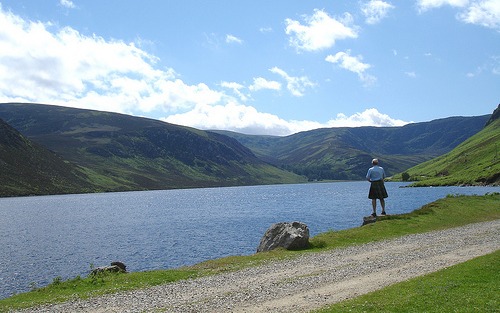
One of the more interesting terms I ran across was the sgian dhu (which appears to be pronounced SKEEan doo, please correct me if someone has a different understanding), the ceremonial knife carried in the stocking of traditional clansman. Besides the knife, there are so many traditions associated with the regalia that I was detoured a bit with my own research into the history of this small knife and the variations depending on clan, etc. I even found a site that is all about kilts (and shares once and for all what men really wear underneath them) which can be found here.
I really enjoyed Claire's little detour in her mind considering the significance of the stones:
...the spot would have been one of terrible mystery and powerful magic; a spot where people would have disappeared without warning. Or appeared, perhaps, out of thin air.
This whole logical-consequence-imagining of Claire was very interesting to me in the sense of where the story may take us. This aligns neatly with legends and fairy tales and anchors the story firmly in legends. This is a very powerful literary device and, to my way of thinking, gives the Outlander story the mythic fuel it needs to outlive its current generation.

Interrupting her thoughts, Dougal and Jamie have an argument regarding the ethics of Dougal's agenda to leverage Colum's authority for support of the Stuart rebellion. The exchange is edged with tension, as Dougal challenges Jamie's allegiance:
"Your obedience is to the chieftain of the clan, and outside of Leoch, I am Colum's head and arms and hands as well as his legs."
"And never saw I a better case of the right hand not knowin' what the left is up to," came the quick rejoinder..."What d'ye think the right is going to say about the left collecting gold for the Stuarts?"
Jamie's response is sharp and witty, and once again, another reference that has a foundation in scripture. The original context applies to money that is given to the poor, not financing a war-chest:
Matt. 6:3-4  But when thou doest alms, let not thy left hand know what thy right hand doeth: That thine alms may be in secret: and thy Father which seeth in secret himself shall reward thee openly.
Whether intentional or not, the irony of using that reference in the context of war and rebellion had impact on me. While it was explained earlier in the story that Jamie lived at a monastery for four months which cured him of his swearing, I suppose he could have picked up a couple of Bible passages here and there. For the common rural clansman of the day, though, quoting scripture might not come as easily since printed Bibles were not something as readily available as we have in this day and age; a reference like that might be a bit more obscure.

I did enjoy the brief sword fighting lesson Jamie shared with Claire; now I have some tactics I can use in my next broadsword fight at work. (I'm sure they'll never expect me to use a left-handed sgian dhu to gain the advantage).

Tuesday, June 24, 2014

Chapter 9 - The Gathering

As Claire is settling in to her new routine in the 18th century (as much as can be expected, anyway), she recounts some of the daily activities that are becoming common pleasantries: helping in the kitchen, visiting the stables, working in the castle garden.
I would join the gathering in the Great Hall to listen to the evening’s entertainment of stories, song, or the music of harp or pipes. I could listen to Gwyllyn the Welsh bard for hours, enthralled in spite of my total ignorance of what he was saying, most times.
Sometimes I like to just listen to international music when I just want to listen to some contemporary beats without being assaulted by lyrics. What I call "international music" is essentially any kind of world music which is either instrumental or where I don't understand the language. Since I only speak and understand English, the field is pretty wide open! Maybe Brazilian or European folk music, doesn't matter; as long as I can't understand what they're saying so I don't have to think about it, just enjoy it for what it is. That's how I picture Claire's enjoyment of the bard.

When she gets invited to go berry picking, she relates a bit of the routine:
We plucked only the best, dropping them into our baskets in juicy heaps, eating as much as we could hold, and carrying back the remainder to be made into tarts and pies.
This brought to mind a memory of me of "helping" my mother to pick strawberries when I was just a "wee bairn". I'm surprised when it came time to weigh how many pounds we had picked, that the farm hands didn't want to weigh me on the way out of the berry patch! One in the bucket, two in my mouth, sit in the shade, eat some more, put one or two in the basket, eat another handful -- I'm pretty sure I wan't really much help at all!

Even among the preparations for the Gathering, Claire is still thinking of ways to escape. I like how there is really no plan except just to get back to the rocks at Craigh na Dun...but then what? I'm sure I would be thinking the same thing. Although I've noticed she hasn't mentioned Frank in quite a while...

After Claire befriends Geilie Duncan on the berry picking expedition, she also has an opportunity to meet with her in the nearby town of Cranesmuire to receive some herbs needed for the castle population. Geilie is depicted as a very likeable character, although each time she is described, she is related as having a sharp wit and "a wry-tongued, cynical viewpoint". I had to stifle a laugh, as I couldn't help but think of my oldest daughter; it was practically describing her to a "T", and then I just kept picturing her in the action in the place of Geilie. Can't imagine where she gets that wry wit and cynicism...

While Claire is at the Duncan's home, a commotion begins outside near the town square:
For some time, I had been conscious of noises coming from the street outside, but had attributed them to the traffic of villagers coming from Sunday Mass; the kirk was located at the end of the street by the well, and the High Street ran from kirk to square, spreading from there into a fan of tiny lanes and walks.
The fact that the population is Catholic shows how far removed the village is within the Highlands. Since Catholicism had essentially been outlawed in Scotland after the Reformation, it was only in the remote areas of the Highlands where Catholicism was still practiced, though usually not openly. Recusants as they were called, would be persecuted for not attending Anglican services, and even included some Reformed Protestant Christians (or any dissenters from the Church of England). So to have an open mob of villagers coming from Mass, it would definitely be a localized enclave. Of course, with my very limited understanding of the Jacobite rising, this seems to fit neatly with the socio-politics of the day.

I'm also quite amazed at how deftly the time-oriented perspective is maintained. When Claire equivocates the mob in Cranesmuire to the similar dissociation of the German people in Nazi Germany, she writes:
Looking down on the assembly, standing patiently in the drizzle awaiting a verdict, I suddenly had a vivid understanding of something. Like so many, I had heard, appalled, the reports that trickled out of postwar Germany; the stories of deportations and mass murder, of concentration camps and burnings. And like so many others had done, and would do, for years to come, I had asked myself, “How could the people have let it happen?"
I know at the outset of this blog I stated I was not going to comment on Diana's writing, but I was struck with a thought when I read this passage. As Diana is relating this story, she has to be extremely mindful of writing not from our current perspective, but from Claire's WWII perspective. I noticed in the foregoing passage how she emphasized, "like so many others had done, and would do, for years to come..." Claire could not have known that except in understanding the depth of the German indifference would have historical ramifications, which of course it did. I don't know, a minor point perhaps, but it did make me think how many phrases and references we take for granted that cannot be used by the author because they would not have been in existence in Claire's time in the 1940's. Challenging, indeed.

The tension of the mob scene continues:
...I thought of myself stepping out, alone and powerless, to confront that mob of solid and virtuous citizens, avid for the excitement of punishment and blood to alleviate the tedium of existence.
Some things never change. Similar things excite today: the daredevil stunts, the Indy car crashes, the boxing injuries; people still clamor for these things to "alleviate the tedium of existence".

To me, the most poignant statement comes as Claire struggles with her own inability for action to somehow help this poor tanner's boy:
To stand against a crowd would take something more than ordinary courage; something that went beyond human instinct. And I feared I did not have it, and fearing, was ashamed.
Wow. Just...wow. A courage that goes beyond human instinct; that, to me, is unbelievably profound. Claire's recognition of her lack of this type of courage goes beyond her own shame to us; to me. Can we not identify with some illustration from our own life when we refused to be the one who "stood in the gap" for another? And then felt ashamed for not having done what was right? Wow.

The scene with the tanner's boy at the pillory is central to Claire's adventure in the village that day, and as such we see many insights into the justice of the day: its barbarity and striking cruelty, but also its effectiveness as the young tanner lad, ear pinned to the pillory, was reproved for stealing by the citizens of the community:
...now and then a more sober citizen was to be seen, seizing a moment from the round of daily duties to attend to the moral improvement of the delinquent by means of a few well-chosen words of reproval and advice.
I'm pretty sure I'm not the only one who can think of a few young people who would have benefited greatly from a similar public display and embarrassment. If only our community provided opportunities for more elder involvement with our young people, our streets might become safer environments for all.

While the ear-nailing was extreme, it makes for a great dramatic scene with Jamie and Claire, as Claire convinces Jamie to help her release the lad so he does not have to rip his head free of the nail. I thoroughly enjoyed Claire's mock faint in the orchestration of the distraction so Jamie could pull the nail and help the young lad. Perhaps we meet up with the lad later in the story...?

At first, my initial thought was, again, why would Jamie, who is already shown to be in hiding of sorts, risk exposing himself over such a comparative trivial manner? But then, in the closing narration, the question is answered for me, almost word-for-word as the question had formed in my head:
“But it was a risk to you,” I said, persisting. “I didn’t realize you’d be in danger when I asked you.”
"Ah,” he said, noncommittally. And a moment later, with a hint of amusement, “Ye wouldna expect me to be less bold than a wee Sassenach lassie, now would ye?”
I can hear the collective swooning from here. But it does indeed fit the moment, and of course, Jamie's character nicely.

All in all, this chapter is a clever and briskly moving narrative of village life in those times.